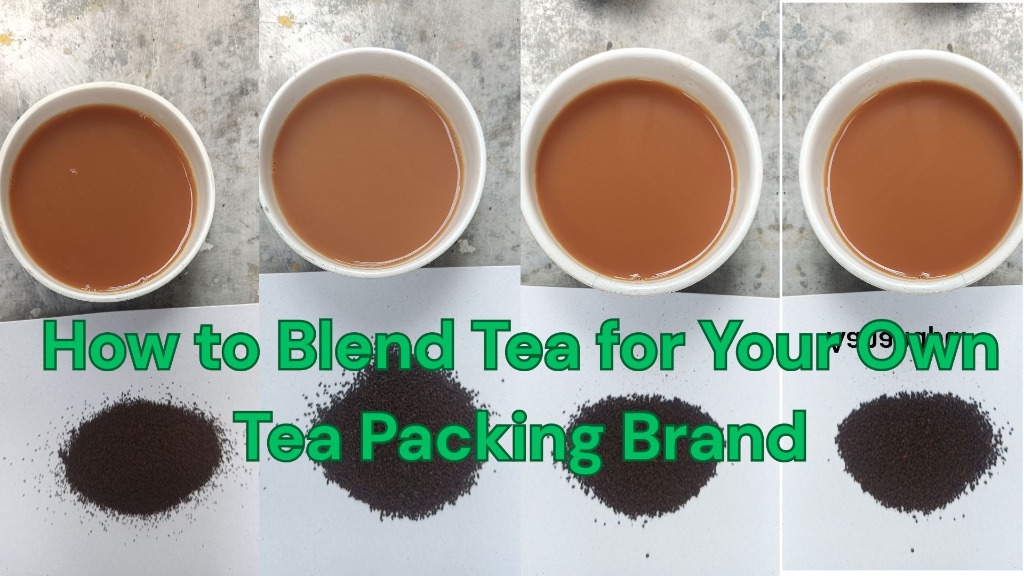
Many new tea brand owners make one big mistake: they buy just one type of tea and pack it as it is. But the real secret behind big national brands like Tata Tea and Wagh Bakri is expert blending. A good blend tastes the same every month, even if the raw tea leaves change a little with the season. That is what blending does — it keeps the taste steady, batch after batch.
The 3 Parts of a Good Tea Blend
A good blend has three parts. Think of them as three knobs you adjust until the tea tastes right:
1. The Base (Body) — 40% to 50%
This gives the tea its "thickness," or karak-pan. Most North and Central Indian brands use Dooars CTC (BOPSM or BP grade) for this. It makes the tea feel strong and full, especially with milk — which is how most Indians drink their tea.
2. The Strength (Colour) — 30% to 40%
This gives the tea its bright red-golden colour. Assam CTC is the best for this. It costs more than Dooars tea, but even a small amount makes the tea brighter and stronger.
3. The Top Note (Smell) — 10% to 20%
This is the smell you notice when you open the packet. A little bit of high-grown Darjeeling dust or a fragrant leaf does the job. It's a small amount, but it makes the tea feel "premium."
How Professional Blenders Test Before Blending: The Table Blend Method
Good blenders don't just guess a ratio and make a full batch. Every batch of tea leaves is a little different, so they test first. This is called a "table blend." Here's how it works:
- Test each tea alone first. Before mixing anything, smell and taste each tea by itself. Brew a small amount (2-3 grams in 100-150ml water) and check the colour, smell, and taste.
- Throw out any tea that fails on its own. If a tea tastes flat, raw, or harsh, don't use it — even a small amount will hurt the final blend. It's much easier to start with good tea than to fix bad tea later.
- Make a small trial batch — 50g to 100g. Mix your teas at the ratio you want, but only a small amount first.
- Taste the mix, not just the parts. Sometimes two good teas don't taste good together. Watch out for an uneven colour — this often happens when you mix a golden tea and a red tea without enough tea to bridge them.
- Add milk before you judge. Most people in India drink tea with milk. So always taste your blend with milk before deciding if it's good. A blend can look perfect without milk but taste flat once milk is added.
- Adjust and try again. If it's not right, change the ratio a little (try 5% at a time) and taste again. Only move to a full batch once the small trial tastes right.
This takes more time than just guessing a ratio once. But it's the reason some blends taste the same every time, and others don't.
Why Tasting Matters More Than the Ratio
It's easy to think a ratio is like a fixed recipe — "45% Dooars, 35% Assam, 15% Darjeeling, done." But real tea isn't that simple. The same type of tea from two different weeks can taste different.
So a ratio is just a starting point, not a fixed rule. This is why tasting is the most important skill for anyone running a tea brand. A trained tongue can catch a bad batch before it goes into full production. If you're new to this, practice tasting often. Compare your blend to a tea you're trying to match. Write down what "good" tastes like, so you don't have to rely only on memory.
Match Your Blend to Your Local Water
Water changes how tea tastes. This is something many new brand owners forget:
- Hard water (water with more minerals — common in parts of Rajasthan, Gujarat, Delhi-NCR, and Punjab-Haryana) makes tea taste weaker and duller. In these places, use more Assam tea to get a strong, bright cup.
- Soft water (water with fewer minerals — common in West Bengal, the North East, and parts of coastal India) brings out colour and strength easily. A lighter Dooars-based blend works well here.
- Mineral-heavy water in industrial and mining areas (like parts of Jharkhand) needs special care too. A blend that tastes great in Kolkata might taste flat or bitter there.
If you sell in more than one area, don't use the same blend everywhere. Test your blend with the actual water from each area you plan to sell in.
A Simple Cost Example
Say you want your blend to cost ₹280-300/kg. Here's how the three parts might add up:
| Part | Ratio | Cost per kg | Cost in the blend |
|---|---|---|---|
| Base — Dooars CTC (BOPSM/BP) | 45% | ₹150/kg | ₹67.50 |
| Strength — Assam CTC | 35% | ₹280/kg | ₹98.00 |
| Top note — Darjeeling dust | 20% | ₹450/kg | ₹90.00 |
| Total blend cost | 100% | — | ≈ ₹255.50/kg |
(These prices are just examples. Garden prices change with the season, so check current rates before you finalise your blend.)
This leaves about ₹25-45/kg for packing, labour, and profit — a workable gap for a family-style blend. If your trial batch costs too much, try cutting the top note a little (it's the most expensive part) and add a bit more base instead. Then taste again to make sure the smell is still good.
You don't need to do this math by hand. Our free Tea Blend Calculator does it for you — just enter your ratios and it shows your cost per kg and your profit margin:
Open Free Tea Blend Calculator →Real Example: A ₹160/kg Hotel Blend We Built for a Client
The family blend example above is good for a retail packet brand. But not every client needs the same thing. Here's a real case to show how different the ratios can be.
A hotel client came to us needing a tea for mass chai service — made in large batches all day, served to guests, and brewed in big urns with milk and sugar. Their target was a strict ₹160/kg. Hotels care about strength and colour per gram, not aroma. The tea gets diluted at scale, so it needs to be strong enough to hold up.
Here's the blend we built:
| Part | Ratio | Cost/kg | Contribution |
|---|---|---|---|
| Base — Dooars CTC (BP/Dust, for max strength) | 70% | ₹150/kg | ₹105.00 |
| Strength — Assam CTC (economy grade) | 30% | ₹183/kg | ₹54.90 |
| Total | 100% | — | ≈ ₹160/kg |
(Illustrative figures — actual garden rates shift with the season.)
Notice what changed compared to the family blend: the base jumped to 70% instead of 40-50%, and there's no top note at all. That's because hotel chai doesn't need a nice opening smell — it just needs to be strong, consistent, and hold up well with milk and sugar. Cutting the Darjeeling top note entirely is what kept the cost exactly on target.
What about adding Darjeeling fannings? We can add a small amount (around 5%) if a client wants a slightly rounder aroma — but it pushes cost above ₹160/kg. For most hotel chai service, the plain two-component blend does the job. We only add it when the client specifically asks.
We tested this the same way as any other blend: tasted each component alone first, ran a 50g trial, then confirmed it with milk (the way the hotel kitchen actually brews it). The blend landed right on ₹160/kg.
This is the kind of work our Private Label Tea Service does — a blend built for your price point, your use case, and tested before it ever reaches your kitchen.
A Quick Checklist Before You Make a Full Batch
Check for these warning signs before scaling up your trial blend:
- Uneven colour — mixing a golden tea and a red tea without enough of a bridging tea often looks patchy.
- Weak smell — if the top note isn't strong enough, the packet won't smell good when opened.
- Harsh or raw taste — this usually means one tea wasn't tested and rejected before mixing.
- Good without milk, bad with milk — always do your final check with milk, since that's how most people drink it.
Getting Started With Your First Blend
Not sure where to start? You don't have to figure it out alone. At Manish Tea Traders, we've been sourcing and blending tea from Siliguri since 2004. We use the same table-blend and taste-test method described above, batch after batch, for over 20 years.
If you choose our Private Label Tea Service, our team will build a blend made for your customers, your local water, and your budget — so you can skip the trial and error.