The tea market in India is huge, but so is the competition. The good news: you don't need lakhs of rupees or your own factory to get started — a small, focused tea business can realistically launch with a budget as low as ₹25,000. Here's exactly how.
Step 1: Define Your Niche
Don't just sell "tea" — sell "Kadak Chai for Students" or "Premium Orthodox for Health-Conscious Buyers." A ₹25,000 budget doesn't stretch far enough to compete on everything at once, so pick one clear customer and one clear positioning before you spend a rupee. A tea stall supplier, a corporate office pantry supplier, and a health-focused D2C brand are three completely different businesses built on the same base ingredient — decide which one you're building.
Step 2: The ₹25,000 Budget Breakdown
Here's roughly how that budget can realistically be allocated for a first small batch:
| Item | Approx. Cost | % of Budget |
|---|---|---|
| Bulk CTC tea (100–150 kg @ ₹150–200/kg) | ₹15,000 – ₹22,500 | ~60% |
| Packaging (pouches, sealing, stickers) | ₹5,000 | ~20% |
| Licensing (FSSAI Basic + Trade License) | ₹1,500 | ~5% |
| Marketing/travel (samples, fuel, local trips) | ₹3,500 | ~15% |
| Total | ≈ ₹25,000 | 100% |
(GST registration isn't included here since most local, intra-state startups at this scale don't need it yet — see Step 3 for exactly when it becomes required.)
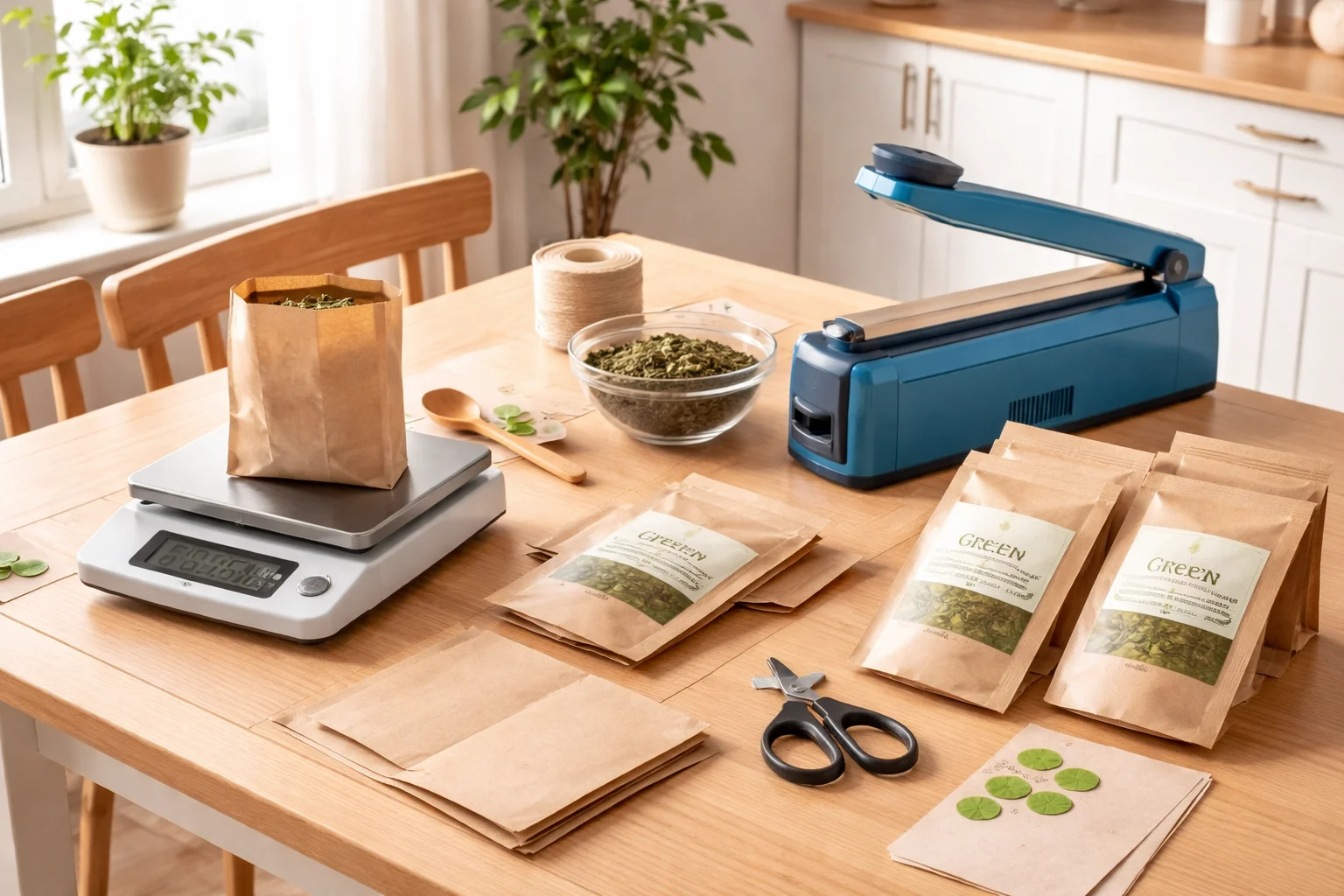
This gets you a real, sellable first batch — repacked into 250g or 500g pouches — without needing a factory, a large warehouse, or a big opening order. Use our free Tea Blend Calculator to work out your own exact batch cost before you commit: Open Free Calculator →
Sourcing tea for your business?
Get wholesale pricing on premium CTC, Assam, and Darjeeling teas. We dispatch free samples across India within 48 hours.
Request Free Samples →Step 3: Legal Basics (and What You Can Actually Skip at First)
Here's the truth most guides get wrong: you don't need every registration on day one. Here's what's actually required, what's genuinely optional at your stage, and what's free money you're probably leaving on the table.
FSSAI License — Mandatory, and Cheap to Self-File
Any food business needs this, no exceptions. For a small startup, you only need FSSAI Basic Registration, which costs roughly ₹100 per year. You can file this yourself directly on the FoSCoS portal (the government's official FSSAI portal) without hiring an agent — it's a simple form, not a complex application. Don't let anyone charge you thousands of rupees for something this straightforward.
GST Registration — Often NOT Required When You're Starting Out
This is the most misunderstood step, and many new entrepreneurs pay for GST registration they don't actually need yet. The real rule:
- You only need GST if your annual turnover crosses ₹40 lakh (for a goods business in most states) — or
- You sell to a customer in another state (interstate supply) — this triggers mandatory GST registration regardless of how small your turnover is.
If you're selling locally, within your own state, and your turnover is well under ₹40 lakh — which describes almost every ₹25,000-budget startup — you do not need GST registration to begin. You can register later, voluntarily, once you actually cross the threshold or want to sell interstate, and you'll also unlock input tax credit at that point. Don't let anyone tell you GST is a day-one requirement if you're just testing the market locally.
MSME / Udyam Registration — Free, and Worth Doing Immediately
This one's genuinely free and takes about 10–15 minutes online (udyamregistration.gov.in), using just your Aadhaar number — no documents to upload. It's not legally mandatory, but skipping it means missing out on real benefits:
- Priority access to government loan schemes
- Collateral-free loan guarantees
- Protection against delayed payments from buyers
- Eligibility for various government subsidy schemes
There's no cost and no real downside — most new tea businesses should register on day one.
Trade License — Check With Your Local Municipality
Depending on your city/town, a Trade License from your local municipal corporation may be required to legally operate, even as a small reseller. Costs are generally modest and vary by location — contact your local municipality directly to confirm requirements and fees for your area.
Free or Subsidised Government Loans Worth Knowing About
If ₹25,000 feels tight and you want to start slightly bigger, several government schemes exist specifically to help small entrepreneurs like a first-time tea business — most require Udyam registration first:
- PMFME (PM Formalisation of Micro Food Processing Enterprises): Built specifically for small food processing businesses — tea packaging qualifies — offering a credit-linked subsidy of up to ₹10 lakh plus support with business formalisation.
- MUDRA Loan: Collateral-free loans up to ₹10 lakh across three tiers (Shishu up to ₹50,000, Kishor up to ₹5 lakh, Tarun up to ₹10 lakh). New businesses with no financial history can qualify, though a clean personal credit record helps.
- PMEGP (Prime Minister's Employment Generation Programme): Offers a 15–35% margin money subsidy on your project cost for new manufacturing or service units — meaning a real chunk of your setup cost can come as a subsidy, not a loan you repay in full.
These schemes involve some paperwork and a basic project report, so they're not "free money instantly" — but for a serious first-time entrepreneur, they can meaningfully lower how much of your own capital you need to risk upfront.
Step 4: Sourcing (The Most Critical Step)
You don't need to own a tea garden. You need a reliable supply partner. This is where Manish Tea Traders comes in — we act as your backend supply chain, so you can focus on building the brand instead of managing sourcing logistics.
- We provide consistent quality batch after batch, so your packet tastes the same every month — the single biggest thing that keeps repeat customers coming back.
- We offer loose tea in bulk starting from manageable quantities (30kg sacks), so you're not forced into a container-scale first order.
Step 5: Packaging (Private Label, If You Want a Brand)
You don't need a factory for this either. We offer private label tea packaging — you choose the blend (for example, our Rajni Gold), and we pack it in pouches with your own brand name and logo. You focus on marketing and sales; we handle sourcing and manufacturing.
If your first ₹25,000 batch goes well, private label is the natural next step once you're ready to build a repeat-customer brand instead of just reselling loose tea.
The Practical Strategy: Stretching ₹25,000 Further
Beyond the budget and legal basics, a few tactical choices make a real difference at this scale.
Don't Rent a Shop Yet
Start from home — use a spare room as your godown. Rent is one of the fastest ways to eat into a ₹25,000 budget before you've made a single sale. Prove the business works first; the shop can come later, funded by actual profit rather than upfront risk.
Focus on Just 2 Products
Don't try to launch Green Tea, Earl Grey, and Masala Chai all at once. With this budget, pick two clear products and do them well:
- A strong Hotel Dust — for tea stalls, who care about strength and fast brewing above all else.
- A Family Blend — for neighbours and local shops, balancing taste and strength for home use.
Trying to cover every niche at once with a small budget usually means doing none of them well.
A Smart Packaging Shortcut
Skip cylinder printing at this stage — it typically costs ₹15,000–50,000 upfront (see our packaging comparison guide for the full cost breakdown), which is more than your entire starting budget. Instead, buy plain silver or gold pouches (roughly ₹250/kg) and get stickers printed at a local print/Xerox shop (around ₹1 per sticker). It looks professional enough to start, and you can move to proper cylinder printing later once you have real, repeatable order volume.
Getting Your First Customers
- Sample to tea stalls directly: Give 250g free samples to 15–20 nearby tea stalls. Even a modest conversion rate from this can start real recurring revenue — a handful of regular stall orders adds up faster than you'd expect at this scale.
- Start with friends and family: A simple "launch discount" for people who already know and trust you is often the fastest way to get your first real sales and honest feedback.
Frequently Asked Questions
How can I start a tea business in India with ₹25,000?
Buy 100–150 kg of bulk CTC tea from Siliguri at ₹150–200/kg, repack it into 250g or 500g pouches, and sell to local retailers and tea stalls. No factory is needed — Manish Tea Traders also offers private label packaging from a low MOQ of 50 kg, so you can launch a branded product from the start if you prefer.
What licenses are required to start a tea business in India?
Only FSSAI Basic Registration is truly mandatory from day one — it costs about ₹100/year and you can self-file it on the FoSCoS portal. GST registration is often not required at the start — you only need it once your turnover crosses ₹40 lakh, or if you sell to customers in another state. A Trade License may be needed depending on your municipality — check locally. Also register for Udyam/MSME (free, ~10-15 minutes online) — it's not mandatory but unlocks government loan schemes like MUDRA and PMFME. A trademark is worth considering later, once you've settled on a brand name.
Is the tea business profitable in India?
Yes — tea is one of India's most stable businesses. Wholesale margins run 10–15% on bulk supply and 40–50% on branded retail packets, with premium private label models yielding 60–100% gross margins. India's tea consumption grows 2–3% annually and is broadly recession-resistant, making it a strong long-term business to build.