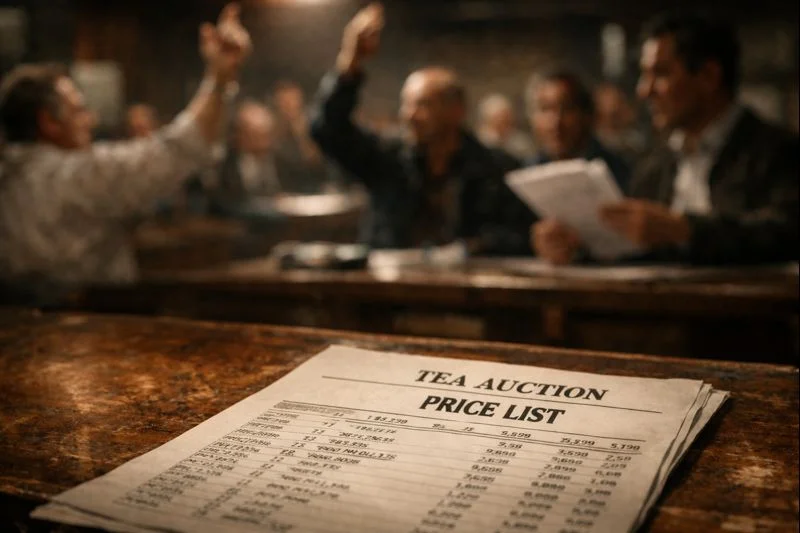
If you're sourcing wholesale tea in North Bengal, you've likely come across reference rates tied to the weekly auctions. But how does the Siliguri tea auction market price list actually come together, and can a business like yours actually buy through it?
This guide explains how the Siliguri Tea Auction Centre (STAC) works, the brokers who run it — including Parcon, J. Thomas & Co., and others — garden-wise pricing dynamics, and why most small and mid-size buyers source through a partner rather than the auction floor directly.
How the Siliguri Tea Auction Works
The auction follows a structured, weekly cycle connecting tea estates to wholesale buyers through registered brokers. A tea lot moves through three stages:
- Garden to broker: Tea estates manufacture CTC or orthodox teas, pack them into bags, and send them to registered warehouses in Siliguri. Each garden assigns its lots to a registered tea broker.
- Cataloguing & sampling: The broker catalogues each lot — garden name, grade, invoice number — and publishes it ahead of the sale. Brokers distribute small samples of each lot to registered buyers for pre-auction tasting. Buyers evaluate these samples, ideally following a structured process like the one in our tea quality identification guide, before deciding how to bid.
- Bidding: On designated auction days, brokers run the sale (increasingly via electronic bidding), and lots go to the highest registered buyer.
The Siliguri Tea Auction Centre (STAC)
STAC was officially inaugurated on 29th October 1976. At inception, it had just 16 seller members, 132 buyer members, and 7 broker members, working out of under 40,000 sq. ft of warehouse space. Today the centre handles tens of millions of kilograms annually and is the third-largest tea auction centre in India by volume, behind Kolkata and Guwahati. It sits in Mallaguri, Siliguri, making it the primary price discovery point for Terai and Dooars gardens.
For official enquiries: STAC, Mallaguri, P.O. Pradhan Nagar, Siliguri, West Bengal 734003.
Tea Auction Brokers in Siliguri
Brokers are the licensed intermediaries who value tea, compile the catalogue, and run the sale on a garden's behalf. Several established firms operate at Siliguri and the other North India centres:
- J. Thomas & Co. — the world's largest and oldest tea brokerage, founded in the 19th century, handling roughly a third of all tea auctioned across India nationally (all auction centres combined — Kolkata, Siliguri, Guwahati, and the southern centres). Their Siliguri office is based in Uttorayon, Matigara.
- Parcon India Private Limited — the second-largest tea broker specifically within North India (Kolkata, Siliguri, and Guwahati), a narrower regional ranking rather than a national one. Operating since 1991, handling over 100 million kg annually. This is the firm most people mean when searching "Parcon tea auction price" or "Parcon tea auction price list PDF."
- Contemporary Brokers and Paramount Tea Marketing — both established, currently active North India tea brokers, alongside J. Thomas and Parcon, handling auction lots and catalogue distribution for various gardens.
A quick clarification since it can look contradictory at a glance: J. Thomas is the largest broker nationally, across all of India's auction centres combined. Parcon's "second-largest" claim is specifically within North India's three centres — a narrower regional comparison, not a competing claim to J. Thomas's national position.
Buyers track these brokers' weekly catalogues and price sheets to monitor garden-wise auction trends. Interpreting them and matching them to your specific blend requirements, though, takes real time and trade expertise.
Sourcing tea for your business?
Get wholesale pricing on premium CTC, Assam, and Darjeeling teas. We dispatch free samples across India within 48 hours. Request Free Samples →
Can You Buy Directly from J. Thomas or Parcon?
This is a common point of confusion worth addressing directly: no, not as a retail buyer or small business, at least not without going through formal registration first.
Brokers like J. Thomas and Parcon work on behalf of tea gardens (as the seller's agent) and sell to registered auction buyers — not to the general public or to a business calling in asking for a few bags of tea. To buy directly through them, you would need to:
- Register as a buyer member with the relevant auction centre
- Meet documentation requirements (valid GST number, FSSAI licensing, and typically a security deposit)
- Purchase in full auction lots — commonly in the range of 120-240kg or more per invoice, not smaller trial quantities
- Have the trade expertise to evaluate samples and bid competitively against experienced buyers
This is a genuinely high barrier for a first-time or small-to-mid-size buyer — it's built for established, high-volume trading houses, not a retailer testing a new supply line. This is exactly the gap a partner like Manish Tea Traders fills: we hold the buyer registration, relationships, and trade expertise, and pass the sourcing through to you in manageable volumes without you needing to navigate broker registration yourself.
Garden-Wise Pricing: What It Means and Why It Fluctuates
Auction prices are rarely flat — they shift garden-by-garden based on:
- Estate reputation: Renowned gardens maintaining high quality and strict FSSAI compliance command higher bids than smaller, unbranded factories.
- Flush quality: Quality shifts dramatically through the year. For Darjeeling teas specifically, prices peak during the First and Second Flush (roughly February to June) — see our Darjeeling flush guide for the full seasonal breakdown.
- Grade and leaf size: Bold leaf grades (BP, BOP) draw different bidding interest than fine dust grades (PD, Dust), depending on whether blenders are building household tea or hotel-style chai mixtures.
Tea Factories in Siliguri: Directory & Sourcing
If you're searching for a "Siliguri tea factory list" or "Siliguri tea factory contact number," you're likely trying to skip the auction system entirely and buy straight from the processing unit. It's worth knowing this presents real challenges for small and mid-size buyers before you go down that road:
- Factories typically sell in large minimum volumes — often 1,000kg+ per grade.
- A single factory's output quality can vary week to week based on green leaf intake.
- Managing logistics, transport permits, and quality testing across multiple factories requires genuine on-ground presence.
Manish Tea Traders maintains direct sourcing relationships with verified gardens and processing units across the region. We manage the quality vetting, price negotiation, and logistics — giving you factory-level sourcing without needing to build and manage those relationships yourself.
Why Buy from Manish Tea Traders Instead of the Auction Directly?
To bid directly at the Siliguri auction, you need buyer registration, security deposits, and the ability to purchase full auction lots — with no consistency guarantee, since every lot is different, even from the same garden.
Manish Tea Traders acts as your practical sourcing partner: we buy bulk auction lots, blend them to your specific local water and taste profile (see our blending guide for how this works), and supply consistent, quality-checked tea in manageable volumes — MOQ of just 30kg — with no registration fees or broker overhead on your end.
Looking for the latest wholesale prices?
We keep our rates aligned with weekly auction trends to ensure you get a fair deal. Download our latest price guide or get a live quote on WhatsApp.
📄 Download Price List & Guide →Frequently Asked Questions
How do I get the Siliguri tea auction price list?
Official weekly price lists are published by registered auction brokers like J. Thomas & Co., Parcon, Contemporary Brokers, and others — but they list hundreds of raw garden invoices, not a simplified market view. For a clean, simplified B2B price list by grade, download the Manish Tea Traders indicative price list or message us directly on WhatsApp.
What is Parcon tea auction, and how does it relate to pricing?
Parcon India Private Limited is the second-largest registered tea broker within North India specifically (Kolkata, Siliguri, and Guwahati) — a regional ranking, distinct from J. Thomas & Co.'s position as the largest broker nationally across all of India's auction centres. Parcon values, catalogues, and auctions tea on behalf of gardens, and its weekly sale reports are widely referenced to track general market rates by grade — but it sells to registered auction buyers, not directly to retail or small wholesale customers.
Can I buy tea directly from J. Thomas & Co. or Parcon?
Not without registering as a buyer member at the relevant auction centre, which requires GST and FSSAI documentation, a security deposit, and purchasing in full auction lots (commonly 120-240kg+ per invoice). Most small and mid-size buyers instead work with a registered auction buyer like Manish Tea Traders, who handles this process and supplies smaller, consistent volumes directly.
Where can I find a list of tea factories in Siliguri?
Dozens of processing factories operate across the Terai and Dooars regions surrounding Siliguri. Since direct factory sourcing typically requires large minimum volumes and hands-on quality management, working with a partner like Manish Tea Traders gives you access to a vetted factory network at a much lower investment.
Do I need to register as a buyer to purchase tea from the Siliguri auction?
Yes. Buying directly from STAC requires registered buyer membership, a valid GST number, FSSAI licensing, and purchasing full auction lots. Partnering with an already-registered auction buyer like Manish Tea Traders removes these administrative barriers entirely.